
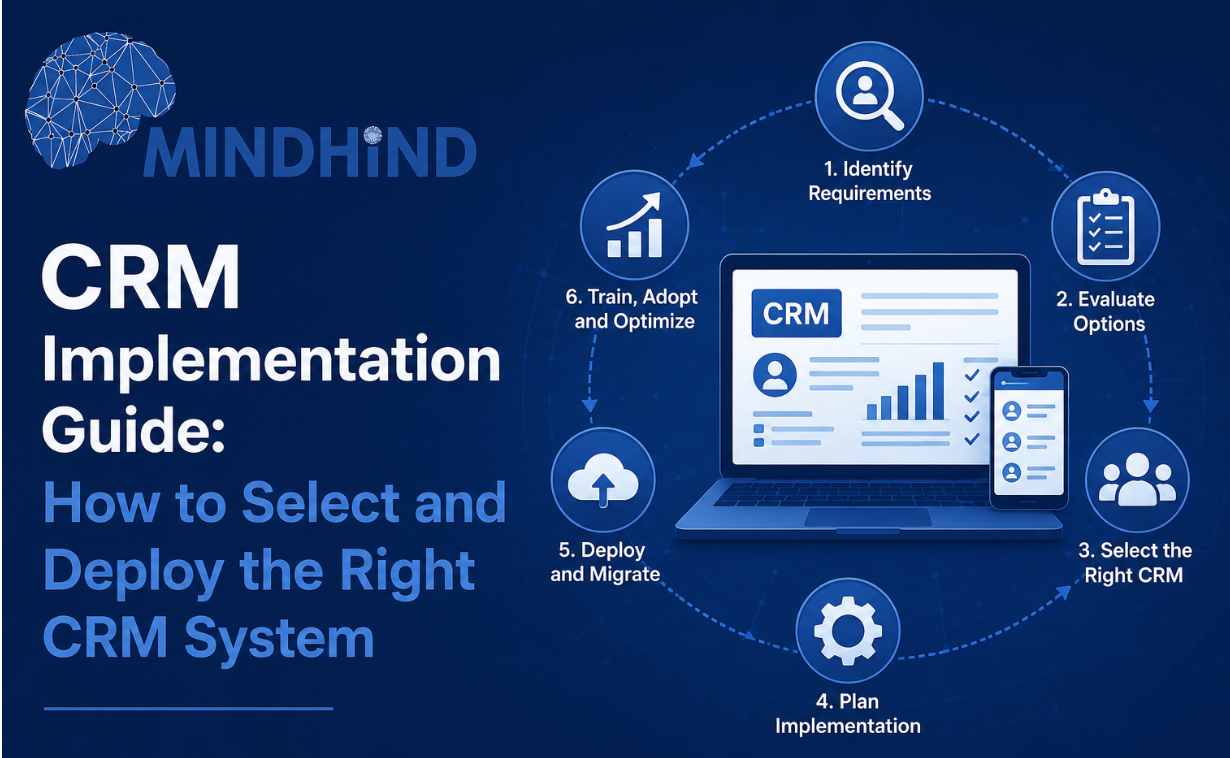
A CRM should do more than store customer names and contact details. It should help sales, marketing, and service teams manage leads, track conversations, automate follow-ups, and make better decisions.
However, many CRM projects fail because businesses choose a platform before understanding their processes. A successful CRM implementation begins with clear requirements, structured customer data, defined workflows, and a plan for employee adoption.
Define Business Requirements and Select the Right CRM
The first step is to understand what the business needs from a customer relationship management system.
Organizations should review how leads are generated, assigned, followed up, converted, and supported. It is also important to identify reporting gaps, manual tasks, duplicated data, and communication delays between departments.
Key questions may include:
- Which teams will use the CRM?
- What customer information should be recorded?
- Which sales stages need to be tracked?
- What reports and dashboards are required?
- Which existing platforms need to be integrated?
CRM platforms should then be compared based on usability, scalability, automation, security, customization, integrations, reporting, and total cost.
The most feature-rich system is not always the best choice. A suitable CRM should support current workflows while remaining flexible enough for future growth.
Working with experienced CRM consulting services can help businesses compare platforms, define requirements, and avoid selecting a system that creates additional complexity.
Plan Data, Workflows, Automation, and Integrations
A strong CRM implementation strategy should define how customer data will be organized and how users will move through the system.
Before migration, existing records should be reviewed, cleaned, and standardized. Duplicate contacts, incomplete information, outdated accounts, and inconsistent fields should be corrected before being transferred.
Sales workflow mapping is equally important. Businesses should define lead stages, ownership rules, follow-up timelines, approval processes, and conversion criteria. These workflows can then be configured within the CRM.
Automation can reduce repetitive work by assigning leads, sending reminders, updating records, creating tasks, and triggering follow-up emails. However, automation should support the sales process rather than make it more complicated.
The CRM may also need to connect with marketing tools, email platforms, websites, finance systems, customer-support software, analytics platforms, or ERP solutions. These integrations create a more complete view of the customer and reduce manual data entry.
Dashboards should be designed around business priorities. Common metrics include lead response time, conversion rate, sales pipeline value, customer retention, average deal size, and sales-cycle length.
Improve Training, Adoption, and CRM Performance
Technology alone cannot guarantee success. Strong CRM adoption depends on how easily employees can use the system and how clearly it supports their daily work.
Training should be practical and role-specific. Sales teams may need guidance on pipeline updates and follow-ups, while managers may need support with reporting, forecasting, and performance tracking.
Employees should also understand why accurate CRM data matters. Incomplete or outdated records can affect forecasting, customer service, campaign performance, and management decisions.
After launch, businesses should monitor login activity, data quality, workflow completion, pipeline accuracy, automation performance, and employee feedback. Low usage may indicate poor training, unnecessary fields, or processes that do not match how teams actually work.
CRM performance should be reviewed regularly. Dashboards, workflows, permissions, and integrations may need to be updated as business needs change.
MindHind’s CRM Consulting services help organizations evaluate sales processes, select suitable CRM platforms, structure customer data, manage migration, and improve adoption.
Review your current sales and customer-management processes with MindHind before selecting or replacing a CRM system.
