
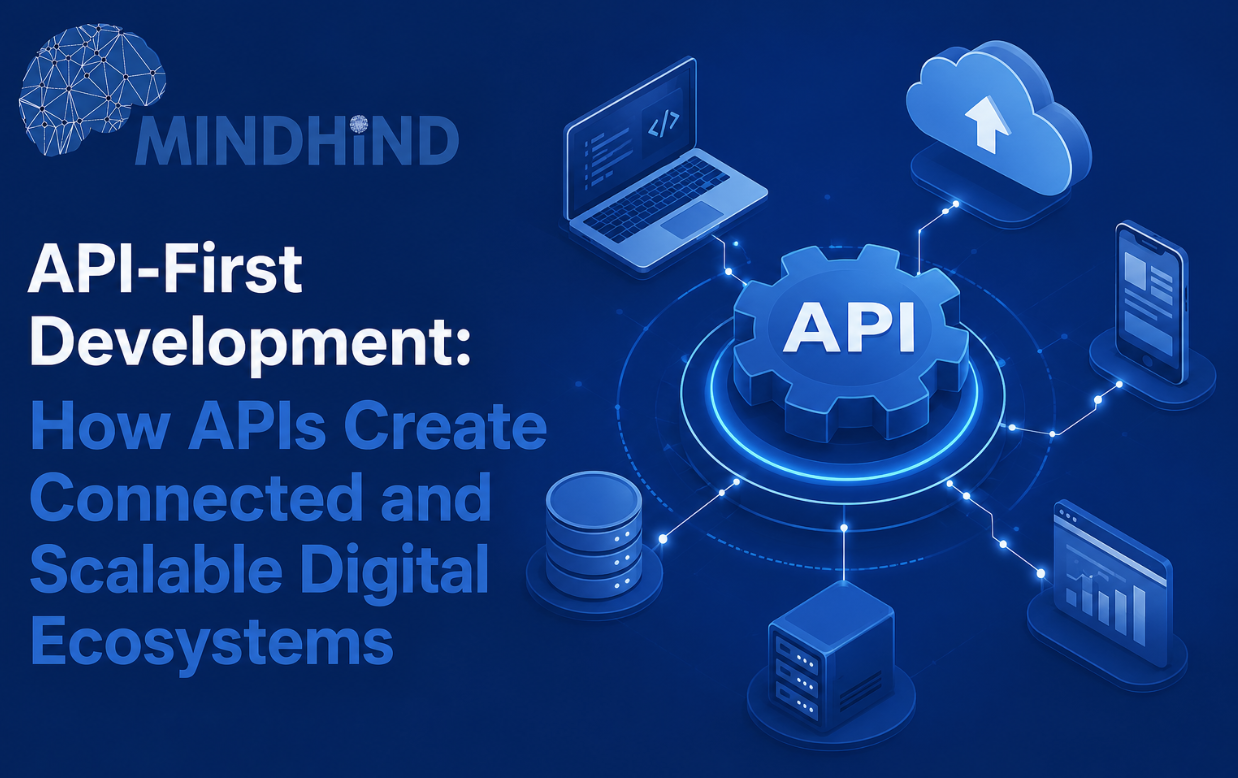
Modern businesses use multiple platforms for customer management, finance, marketing, operations, analytics, and communication. When these systems do not work together, teams depend on manual data entry, duplicated workflows, and disconnected information.
API-first development helps businesses create a connected digital ecosystem where applications, data, and services can communicate securely. Instead of building an application first and adding integrations later, an API-first approach defines how systems will exchange information from the beginning.
This creates a stronger foundation for scalability, automation, faster development, and future technology expansion.
How API-First Architecture Improves Connectivity
An API, or application programming interface, allows different software systems to exchange data and perform actions.
For example, an e-commerce platform may use APIs to connect with payment gateways, delivery providers, inventory systems, CRM software, and analytics tools. These connections reduce manual work and help information move between platforms in real time.
With API integration, businesses can connect cloud applications, legacy systems, mobile apps, customer portals, and third-party services. This improves system interoperability and gives teams access to more consistent information.
An API-first model also supports reusable services. Instead of building the same functionality repeatedly, development teams can create one service and use it across multiple applications.
For example, a secure customer authentication API can support a website, mobile application, partner portal, and internal platform. Reusable services reduce development time and improve consistency across the organization.
Supporting Scalability Through Microservices
Traditional applications are often built as one large system. Updating one part may affect the entire application, making development slower and increasing technical risk.
A microservices architecture divides an application into smaller, independent services. Each service performs a specific function, such as payments, notifications, user accounts, product search, or order processing.
APIs allow these services to communicate with one another. Teams can update, scale, or replace individual services without rebuilding the full application.
This approach is useful for organizations managing high transaction volumes, multiple digital channels, or rapidly changing customer requirements.
A well-defined enterprise API strategy should establish standards for API design, ownership, security, documentation, testing, and maintenance. Without common standards, businesses may create duplicate APIs, inconsistent data structures, and difficult integrations.
API gateways can help manage this environment. They control traffic between users, applications, and backend services while supporting authentication, rate limits, routing, logging, and security policies.
Building and Managing Secure APIs
APIs must be designed with security and long-term management in mind.
Authentication and authorization controls should verify who is requesting access and what actions they are permitted to perform. Common controls include API keys, tokens, role-based permissions, encryption, and identity-management integrations.
Clear documentation is also essential. Developers need to understand available endpoints, data formats, error messages, security requirements, and usage limits. Good documentation reduces integration time and prevents unnecessary development delays.
Versioning helps businesses update APIs without immediately disrupting applications that depend on earlier versions. A structured versioning process gives teams time to test changes and update connected systems.
Performance monitoring should track response times, error rates, traffic volumes, failed requests, security events, and system availability. Continuous monitoring helps teams identify issues before they affect customers or critical operations.
Working with experienced API development services can help organizations design scalable APIs, connect existing platforms, strengthen security, and reduce dependence on disconnected workflows.
MindHind’s API Development and Integration services help businesses create secure, reusable, and scalable connections across applications, cloud platforms, and enterprise systems.
Review your current integration architecture with MindHind to identify where secure APIs can replace manual processes, fragmented data, and disconnected digital workflows.
