
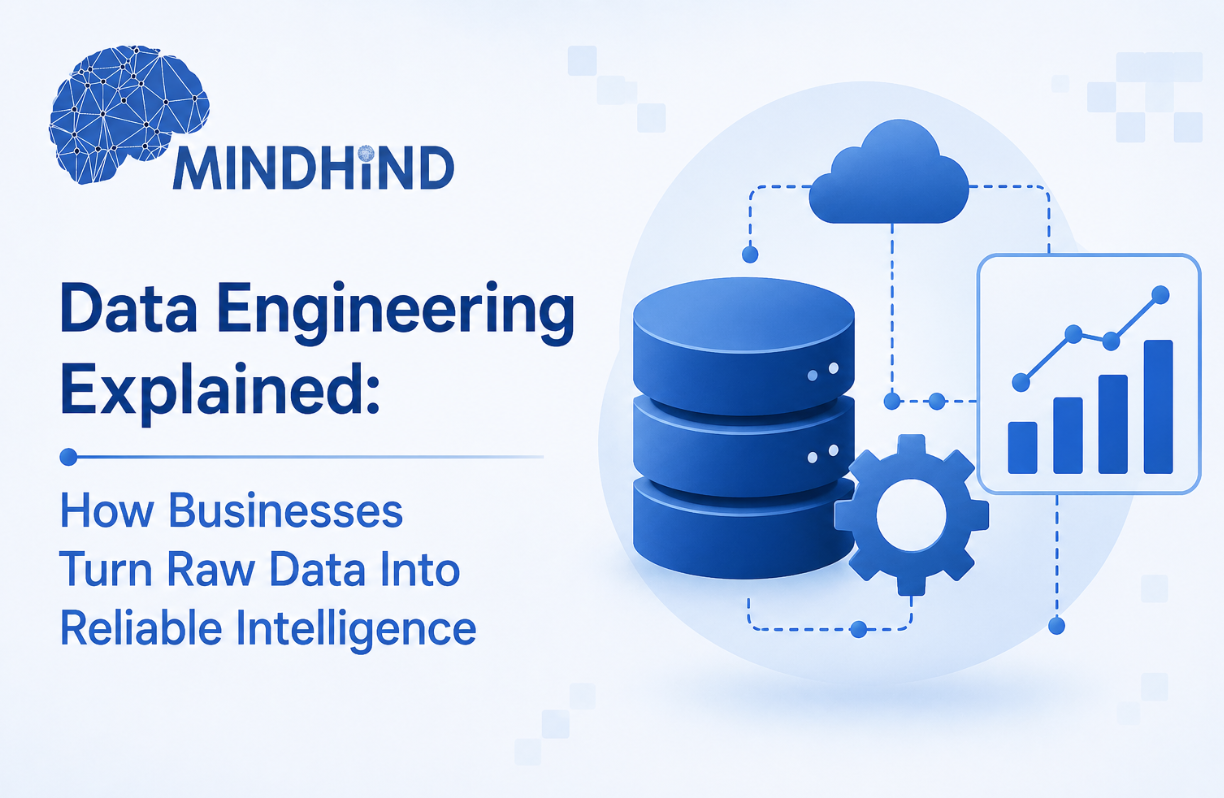
Businesses collect data from websites, CRM systems, ERP platforms, marketing tools, finance software, customer-support systems, mobile apps, and cloud platforms. However, raw data alone does not create business value.
Without proper structure, data can become duplicated, outdated, incomplete, or difficult to access. Data engineering helps organizations collect, clean, organize, store, and prepare data so it can support reporting, analytics, automation, and AI initiatives.
A strong data foundation allows leaders to make decisions based on accurate information instead of disconnected spreadsheets or unreliable reports.
Building Reliable Data Pipelines
Data engineering begins with data collection and ingestion.
Businesses need to bring information from multiple sources into a central environment. These sources may include customer platforms, sales tools, financial systems, inventory software, cloud applications, and third-party databases.
An enterprise data pipeline moves data from these sources into storage systems where it can be processed and analyzed. This pipeline may run in batches at scheduled times or in real time when immediate updates are required.
After ingestion, data must be transformed. This includes cleaning errors, removing duplicates, standardizing formats, matching records, and preparing information for business use.
For example, customer names, dates, locations, product IDs, and sales values may appear differently across systems. Transformation ensures this information becomes consistent and reliable.
Strong data integration helps connect separate systems and creates a single view of business operations. This reduces manual reporting work and improves visibility across departments.
Storage, Validation, and Governance
Once data is collected and transformed, it needs to be stored in the right environment.
A data warehouse is commonly used for structured reporting and business intelligence. It helps teams analyze sales, operations, finance, customer behaviour, and performance metrics.
A data lake can store large volumes of structured and unstructured data, including logs, documents, images, and raw system data. This can be useful for advanced analytics, machine learning, and AI use cases.
Businesses may use both data warehouses and data lakes depending on their reporting and analytics needs.
Validation is an important part of data engineering. Data should be checked for accuracy, completeness, duplication, missing values, and unusual patterns. Without validation, reports may produce misleading results.
Governance defines how data is managed, accessed, protected, and used. It includes ownership, quality standards, security rules, compliance requirements, and documentation.
Working with experienced data warehouse consulting specialists can help businesses design storage environments, improve data quality, and create reporting systems that support long-term growth.
Preparing Data for Analytics, Automation, and AI
Poor data infrastructure can create serious business challenges.
Sales teams may see incorrect pipeline reports. Finance teams may struggle with inconsistent revenue numbers. Marketing teams may not understand campaign performance. Operations teams may lack visibility into inventory, fulfilment, or customer demand.
These issues also affect AI initiatives. AI tools depend on accurate, relevant, and properly organized data. If the data is incomplete or unreliable, AI outputs may be inaccurate, biased, or difficult to trust.
Modern businesses need data systems that can support dashboards, predictive analytics, automation, customer personalization, and enterprise AI use cases.
Real-time pipelines can help organizations act faster by updating data as events happen. This is useful for fraud detection, inventory alerts, customer support, logistics tracking, and operational monitoring.
A scalable data environment should also support future growth. As data volume increases, systems must remain secure, efficient, and easy to manage.
MindHind’s data engineering services help organizations build reliable data pipelines, improve data integration, design data warehouses, strengthen governance, and prepare data for analytics and AI.
Assess your current data infrastructure with MindHind to understand whether it can support reporting, automation, and AI at scale.
