
Introduction
For years, businesses have invested in digital tools to improve efficiency, dashboards, CRMs, automation platforms, and analytics systems.
Yet most organizations still struggle with the same problem: operations are fragmented, slow, and heavily dependent on manual coordination.
That is now starting to change.
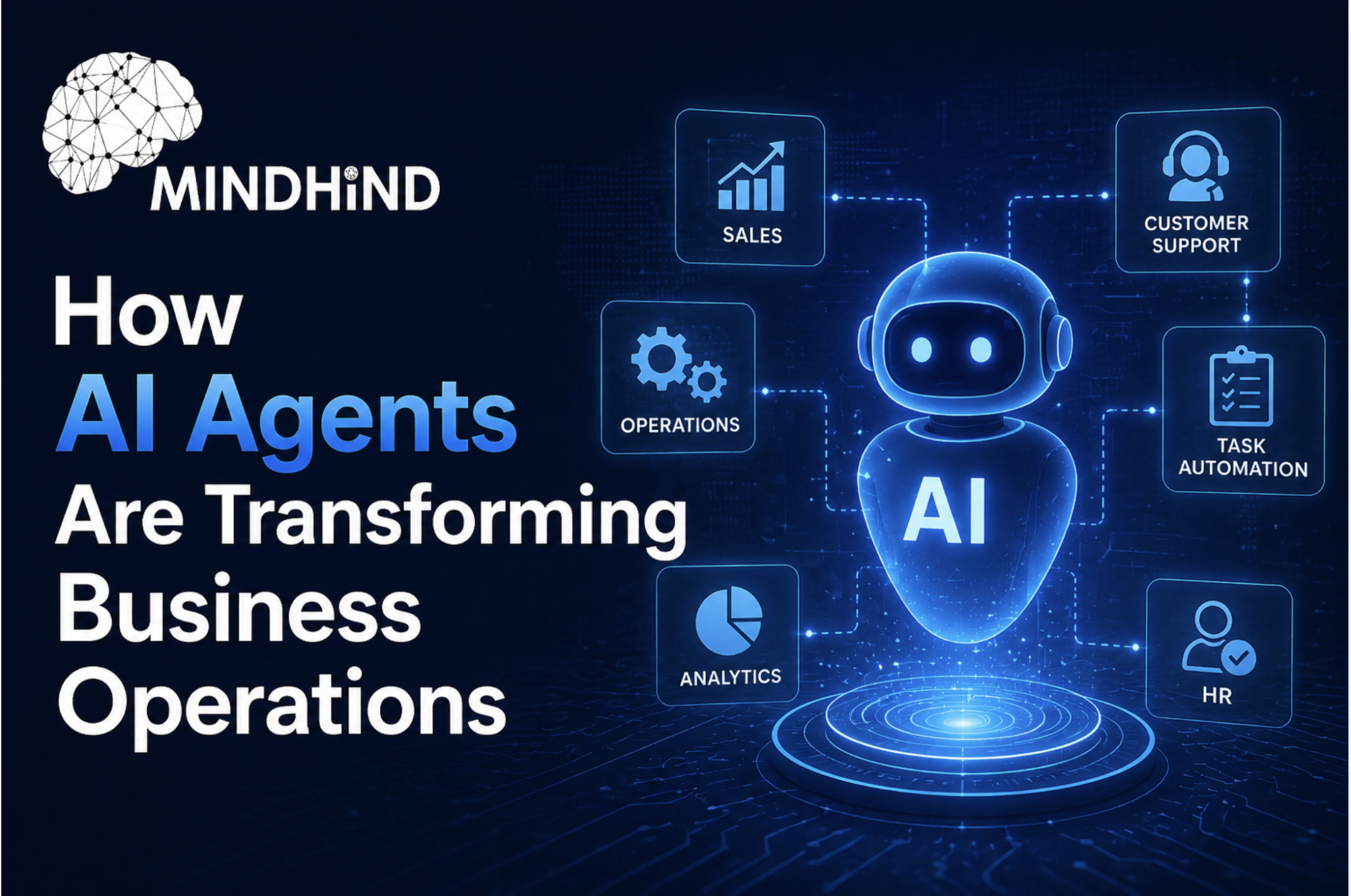
A new category of AI technology is emerging. AI agents: A system that doesn’t just respond to prompts, but actively executes tasks, coordinates workflows, and makes context-aware decisions inside business environments.
This is not an incremental upgrade.
It is a structural shift in how business operations are designed.
Companies that understand this early are already moving from tool-based efficiency to system-driven intelligence.
What AI Agents Actually Do (Beyond the Buzzword)
At a basic level, AI agents are systems that can:
- Understand a business goal
- Break it into structured steps
- Interact with tools and data sources
- Execute tasks with minimal supervision
- Adjust based on real-time inputs
Unlike traditional software, which waits for commands, AI agents operate with intent.
Think of them as digital operators embedded inside your business processes.
For example:
Instead of a manager manually pulling performance data every morning, an AI agent can:
- Extract data from multiple systems
- Identify anomalies or trends
- Generate a concise performance summary
- Send insights directly to decision-makers
The difference is subtle in description but significant in impact.
One is task execution.
The other is work execution.
From Automation to Autonomous Operations
Most businesses are already familiar with automation.
But traditional automation is rigid. It works only when conditions are predefined.
AI agents introduce something fundamentally different: adaptability.
Traditional automation:
- Rule-based
- Linear workflows
- Breaks when conditions change
- Requires manual updates
AI agents:
- Context-aware
- Multi-step execution
- Adaptive decision-making
- Continuous improvement with usage
This shift matters because business operations are rarely linear.
They are dynamic, messy, and constantly changing.
AI agents are designed for exactly that environment.
Where AI Agents Are Already Changing Business Operations
1. Customer Operations: From Reactive Support to Intelligent Resolution
Customer support has traditionally been reactive — teams respond after an issue is raised.
AI agents change that model entirely.
They can:
- Interpret customer queries in real time
- Pull relevant account and order data
- Suggest or execute resolutions
- Escalate complex issues with full context
Example:
An e-commerce company using AI agents no longer relies on agents manually checking order status, refund policies, or delivery updates. The AI handles 70–80% of these interactions instantly, while humans focus on exceptions and high-value cases.
The result is not just faster support, it is consistent service at scale.
2. Sales Operations: Removing Administrative Drag from Revenue Teams
Sales teams often spend less time selling than updating systems.
AI agents are increasingly being used to fix that imbalance.
They can:
- Qualify inbound leads based on behavior and intent
- Summarize sales calls automatically
- Update CRM records in real time
- Generate follow-up messages based on context
Example:
A B2B services company uses AI agents to analyze incoming inquiries and prioritize leads based on deal probability. Sales teams only engage with high-intent prospects, improving conversion efficiency without increasing headcount.
This is where AI shifts from support function to revenue acceleration layer.
3. Marketing Operations: Faster Execution, Smarter Optimization
Marketing teams often struggle with speed of execution and analysis cycles.
AI agents help compress both.
They can:
- Draft campaign assets based on performance data
- Monitor engagement in real time
- Recommend content or targeting adjustments
- Automate reporting workflows
Example:
A performance marketing team uses AI agents to track campaign performance daily and suggest budget shifts across channels based on conversion trends.
Instead of waiting for weekly reports, decisions become continuous.
Marketing becomes less about reporting performance and more about optimizing it in motion.
4. Internal Operations: Eliminating Workflow Fragmentation
This is where AI agents quietly create some of the biggest efficiency gains.
They can:
- Generate operational reports
- Monitor KPIs across systems
- Flag delays or inefficiencies
- Coordinate tasks between departments
- Reduce dependency on manual follow-ups
Example:
A logistics company uses AI agents to track shipment data across vendors, detect delays, and automatically notify both customers and internal teams before issues escalate.
This reduces operational friction and improves responsiveness without adding coordination overhead.
5. Finance & Administration: Real-Time Accuracy at Scale
Finance teams are often constrained by manual reconciliation and reporting cycles.
AI agents are changing that by:
- Processing invoices automatically
- Reconciling transactions across systems
- Detecting anomalies in spending
- Generating real-time financial summaries
Instead of closing books monthly, businesses are moving toward continuous financial visibility.
Why Businesses Are Moving Toward AI Agent Systems
The shift is not happening because AI is trending.
It is happening because operational complexity has outgrown human coordination.
Three pressures are accelerating adoption:
1. Efficiency expectations are rising
Businesses are expected to scale output without proportional cost increases.
2. Operational systems are fragmented
Most organizations now operate across multiple disconnected tools.
3. Speed has become a competitive factor
Faster decisions consistently outperform better-but-slower decisions.
AI agents sit directly at the intersection of these problems.
The Real Business Impact of AI Agents
The value of AI agents is often misunderstood as “automation improvement.”
In reality, the impact is structural.
Businesses experience:
- Reduced operational bottlenecks
- Faster decision cycles
- Lower dependency on manual coordination
- Higher consistency in execution
- Scalable workflows without linear hiring
But the deeper shift is this:
Organizations become execution systems rather than coordination-heavy structures.
Challenges Leaders Should Not Ignore
Despite the potential, AI agents introduce new challenges that require careful design.
1. Undefined processes cannot be automated
AI agents amplify structure, they do not fix broken workflows.
2. Data fragmentation limits performance
Agents are only as effective as the systems they can access.
3. Governance becomes essential
Autonomous systems require clear boundaries and oversight.
4. Over-automation can create blind spots
Not every decision should be delegated to systems.
The goal is not maximum autonomy.
The goal is controlled intelligence.
How Leaders Should Approach AI Agent Adoption
A successful rollout is less about technology and more about operational clarity.
Step 1: Identify high-friction workflows
Focus on repetitive, time-consuming processes with clear inputs and outputs.
Step 2: Map decision flows
Understand where decisions are made and what information is required.
Step 3: Define operational boundaries
Clearly outline what AI agents can automate and what requires human oversight.
Step 4: Start with one system, not everything
Pilot a single workflow before scaling across functions.
Step 5: Align teams early
Adoption depends on trust, clarity, and usability, not just capability.
The Future of Business Operations
AI agents represent a shift from:
manual execution → intelligent systems-driven execution
Over time, businesses will move toward:
- Self-monitoring operations
- Autonomous reporting systems
- AI-assisted decision layers
- Continuous optimization loops
The organizations that adopt early will not just operate faster.
They will operate with higher structural intelligence.
Conclusion
AI agents are not just improving business operations. They are redefining how operations are built.
The shift is moving businesses from fragmented tools and manual coordination toward integrated, intelligent systems that execute work in real time.
However, the advantage does not come from adoption alone.
It comes from implementation discipline, aligning AI with business processes, data systems, and organizational structure.
Companies that approach this transition strategically will gain more than efficiency.
They will gain a fundamentally more scalable operating model.
Build Intelligent Operations with MindHind Consulting Group
MindHind Consulting Group helps organizations design and implement AI-driven operational systems that reduce complexity, improve efficiency, and enable scalable business execution.
We work with leadership teams to move beyond tool adoption and build intelligent, system-driven operations powered by AI.
