
Introduction
Artificial Intelligence has become one of the biggest priorities for modern businesses.
Organizations are investing in AI-powered automation, intelligent analytics, and digital transformation initiatives to improve efficiency and stay competitive.
But there is a growing gap between adopting AI and achieving business results from AI.
Many companies launch AI projects with high expectations only to discover that the technology alone does not create transformation.
The challenge is rarely the AI itself.
The challenge is whether the organization has the right strategy, processes, data, and people to turn AI into measurable business impact.
A poorly planned AI initiative can lead to:
- Wasted technology investments
- Low employee adoption
- Operational disruption
- Unreliable insights
- Projects that never scale beyond testing
Successful AI adoption requires more than selecting a tool.
It requires understanding where AI creates real value, how it fits into existing operations, and how the business will measure success.
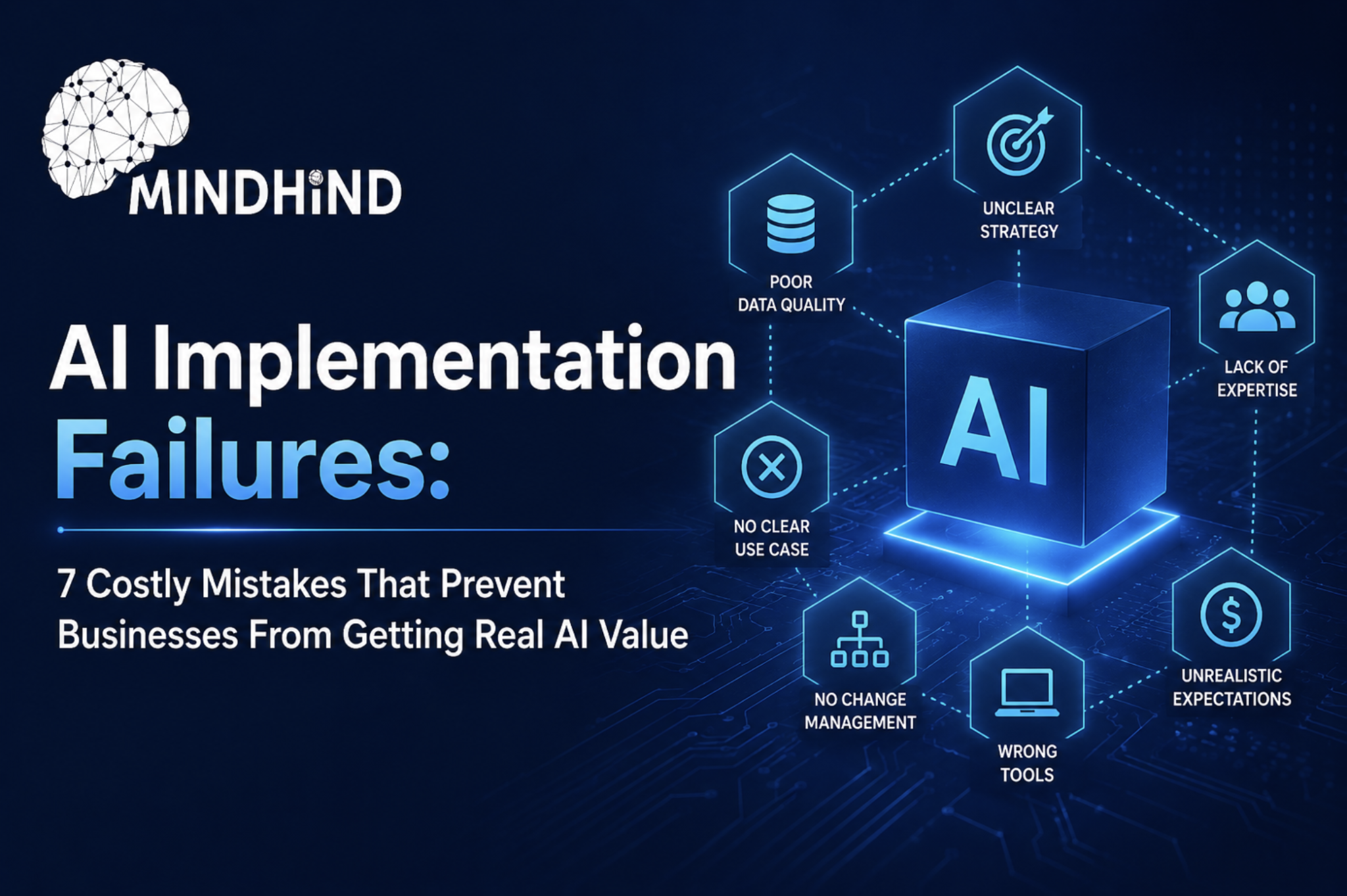
In this article, we explore seven common AI implementation failures businesses make and how leaders can avoid them.
Why Many AI Projects Fail After Successful Launches
At first glance, AI implementation seems straightforward.
A company identifies a process.
A technology solution is selected.
The system is deployed.
But real-world transformation is rarely that simple.
Many organizations discover that AI projects fail because they focus on the technology layer while ignoring the business layer.
Common issues include:
- Implementing AI without a clear objective
- Using poor-quality data
- Choosing tools without considering business fit
- Failing to prepare employees
- Measuring activity instead of outcomes
The biggest misconception is this:
AI is not a software upgrade. It is a business transformation initiative.
Companies that treat it only as a technology project often struggle to achieve long-term value.
1. Starting With AI Tools Instead of Business Problems
One of the most expensive AI mistakes is adopting technology before defining the problem.
Many organizations begin with:
“What AI solution should we implement?”
Instead of asking:
“What business challenge are we trying to solve?”
This creates AI projects that look innovative but have limited impact.
For example:
A company may implement an AI chatbot to improve customer service.
However, if customer issues are caused by unclear processes, outdated information, or poor internal communication, the chatbot only automates the problem.
The technology works.
But the business outcome does not improve.
A successful AI strategy begins with measurable objectives:
- Reduce operational bottlenecks
- Improve customer experience
- Increase decision-making speed
- Automate repetitive workflows
- Improve forecasting accuracy
AI delivers value when it is connected to business priorities.
2. Underestimating the Importance of Data Readiness
AI systems depend on data.
But many businesses attempt AI implementation before understanding the quality of their existing information.
Poor data creates poor outcomes.
Common data challenges include:
- Incomplete records
- Duplicate information
- Outdated databases
- Data spread across disconnected systems
- Lack of ownership
Consider a company implementing AI-driven sales forecasting.
The AI model may be advanced.
But if historical sales data is inconsistent or incomplete, predictions will not be reliable.
The issue is not the AI.
The issue is the foundation.
Before scaling AI, businesses need:
- Clean data structures
- Strong data governance
- Connected systems
- Clear data ownership
A strong AI strategy begins long before the first model is deployed.
3. Choosing AI Solutions That Do Not Fit the Business
The AI market is growing rapidly.
Every industry now has access to hundreds of AI tools promising faster growth and higher efficiency.
But not every solution fits every organization.
A common mistake is selecting technology because it is popular rather than because it solves a specific business need.
For example:
A large enterprise may require customized AI workflows integrated across multiple departments.
A growing company may benefit more from targeted automation in customer support, operations, or reporting.
The right AI solution depends on:
- Business size
- Existing technology environment
- Operational complexity
- Growth goals
The best AI investment is not the most advanced tool.
It is the one that creates the highest business impact.
4. Ignoring Employee Adoption and Change Management
Technology does not transform businesses.
People do.
Even the most powerful AI system will fail if employees do not trust it, understand it, or use it effectively.
Many AI projects face resistance because teams worry about:
- Job changes
- Lack of control
- Unfamiliar workflows
- Increased complexity
For example:
A company introduces AI automation to reduce manual reporting.
However, employees continue creating reports manually because they were never trained on the new system.
The company invested in AI.
But the organization never adopted it.
Successful AI transformation requires:
- Clear communication
- Practical training
- Leadership support
- Employee involvement
The goal is not replacing people.
The goal is helping teams work better.
5. Expecting Instant Results From AI
AI transformation is not an overnight process.
Many businesses expect immediate returns after implementation.
But effective AI systems require:
- Testing
- Optimization
- Feedback
- Continuous improvement
A customer support AI system, for example, improves over time as it learns from:
- Customer interactions
- Common questions
- Business updates
- User feedback
Companies that treat AI as a one-time project often lose momentum.
Companies that treat AI as an evolving capability create long-term advantage.
6. Keeping AI Separate From Existing Business Operations
Another common failure is creating AI solutions that exist outside normal workflows.
An AI dashboard may provide valuable insights.
But if decision-makers continue using old processes, the impact remains limited.
AI needs to become part of daily operations.
That means integrating AI into:
- Decision-making
- Customer interactions
- Internal workflows
- Business planning
- Performance tracking
The purpose of AI is not to create another system.
The purpose is to improve the systems businesses already depend on.
7. Measuring AI Success With the Wrong Metrics
Many organizations measure AI projects by completion:
- Was the system launched?
- Was the software implemented?
- Was the project delivered?
But these measurements do not reveal whether AI created value.
The real question is:
Did the business improve because of AI?
Effective AI measurement focuses on outcomes:
- Reduced operating costs
- Faster workflows
- Better customer satisfaction
- Increased productivity
- Improved decision-making
- Higher business efficiency
The strongest AI initiatives are not the ones with the most advanced technology.
They are the ones that create measurable improvements.
How Businesses Can Build Successful AI Strategies
Avoiding AI failures requires a structured approach.
Start With Clear Business Goals
Identify where AI can create the most value.
Focus on areas where improvement can be measured.
Build a Strong Data Foundation
Before implementing AI:
- Improve data quality
- Connect systems
- Establish governance
- Create reliable information flows
Select Scalable Solutions
Choose AI systems that align with:
- Current needs
- Future growth
- Business capabilities
Prepare Teams for Change
Successful transformation requires people to understand:
- Why AI is being introduced
- How it helps them
- How to use it effectively
Focus on Business Outcomes
Measure AI based on impact, not implementation.
The objective is not adopting AI.
The objective is improving the business.
The Future of AI: Moving From Experimentation to Transformation
AI adoption is entering a new phase.
The next competitive advantage will not come from simply using AI tools.
It will come from building organizations that know how to apply AI strategically.
Future-ready companies will combine:
- Strong technology foundations
- Data-driven decision-making
- Human-centered implementation
- Continuous innovation
AI is becoming part of how businesses operate, compete, and grow.
The organizations that succeed will be those that approach AI with discipline, not hype.
Conclusion
AI implementation failures rarely happen because businesses lack access to technology.
They happen because organizations underestimate the strategy required to make AI successful.
Real AI transformation requires:
- Clear objectives
- Strong data
- Business alignment
- Employee adoption
- Continuous improvement
The future belongs to companies that move beyond experimenting with AI and start building intelligent systems that create measurable business value.
Build Your AI Transformation Strategy With MindHind Consulting Group
Businesses that approach AI strategically can achieve more than automation, they can unlock smarter operations, faster decisions, and sustainable competitive advantage.
MindHind Consulting Group helps organizations navigate AI adoption and digital transformation with practical strategies designed around real business outcomes.
